.jpg)


Showing posts with label Taj Mahal. Show all posts
Showing posts with label Taj Mahal. Show all posts
Amazing Facts About Tajmahal-History of Tajmahal
HistoryAmazing Facts About Tajmahal-History of TajmahalMumtaz and Shah Jehan were married in 1612 A.D had 14 children together. The Empress Mumtaz used to accompany her husband in his military campaigns, and it was in Burhanpur in 1630, that she gave birth to her last child, after which she died. So great was the Shah Jahan's love for his wife Mumtaz, that he ordered the building of the most beautiful mausoleum on Earth for her, The Taj Mahal.
As soon as construction work began in early 1630, sculptors, masons, craftsmen, and calligraphers were called from Persia, Ottoman Empire and Europe to work on construction of the Taj.
The architectural complex of the Taj Mahal comprises of five main elements: the Darwaza or main gateway, the Bageecha or garden, the Masjid or mosque, the Naqqar Khana or rest house, and the Rauza or the Taj Mahal mausoleum.
The actual Tomb of Mumtaz is situated inside the Taj. The unique moghal style architecture combines elements & styles of Persian, Central Asian, and Islamic architecture. Most striking are the black and white chessboard marble floor, the four tall minarets (40 m high) at the corners of the structure, and the majestic grand dome in the middle.
On closer inspection, the lettering of the Holy Quran verses around the archways appear to be uniform. The lettering spacing and density has been customized to give this impression to the viewer. The impressive pietra dura artwork includes geometric elements & style, plants & flowers, which are common in Islamic architecture. The level of sophistication in artwork includes a 3 cm decorative element containing more than 50 inlaid gemstones.
INTERESTING FACTS ABOUT TAJMAHAL
1. Taj Mahal appears pink in the morning, white in the day and changes its color to golden in the moon light.


As soon as construction work began in early 1630, sculptors, masons, craftsmen, and calligraphers were called from Persia, Ottoman Empire and Europe to work on construction of the Taj.
The architectural complex of the Taj Mahal comprises of five main elements: the Darwaza or main gateway, the Bageecha or garden, the Masjid or mosque, the Naqqar Khana or rest house, and the Rauza or the Taj Mahal mausoleum.
The actual Tomb of Mumtaz is situated inside the Taj. The unique moghal style architecture combines elements & styles of Persian, Central Asian, and Islamic architecture. Most striking are the black and white chessboard marble floor, the four tall minarets (40 m high) at the corners of the structure, and the majestic grand dome in the middle.
On closer inspection, the lettering of the Holy Quran verses around the archways appear to be uniform. The lettering spacing and density has been customized to give this impression to the viewer. The impressive pietra dura artwork includes geometric elements & style, plants & flowers, which are common in Islamic architecture. The level of sophistication in artwork includes a 3 cm decorative element containing more than 50 inlaid gemstones.
INTERESTING FACTS ABOUT TAJMAHAL
1. Taj Mahal appears pink in the morning, white in the day and changes its color to golden in the moon light.

2. The pillars surrounding Taj Mahal are slightly tilted outwards so that in the event of an earthquake they will fall away from the tomb.
3. An identical Taj Mahal was supposed to be built in black marble instead of white. The base of it can still be seen across the river.

4. Over 1,000 elephant were used to transport building materials during the construction.
5. In all, 28 types of precious and semi-precious stones were inlaid into the white marble.

6. The Taj Mahal in India is perfectly symmetrical, except for one thing. The two tombs inside are not equal in size. This is because the male tomb has to be larger than the female tomb.
7. The Taj Mahal costs in today’s money about US $100 million.

8. It took 22 years and 22,000 people to complete the Taj Mahal.
9. Twenty thousand workers were employed for the construction work of the Taj Mahal.
10. Emperor ordered to chop off the hands of the workers who had constructed the Taj Mahal so no one could make anything like it.
Source:http://a4afzal.blogspot.in
Shah Jahan and Mumtaz
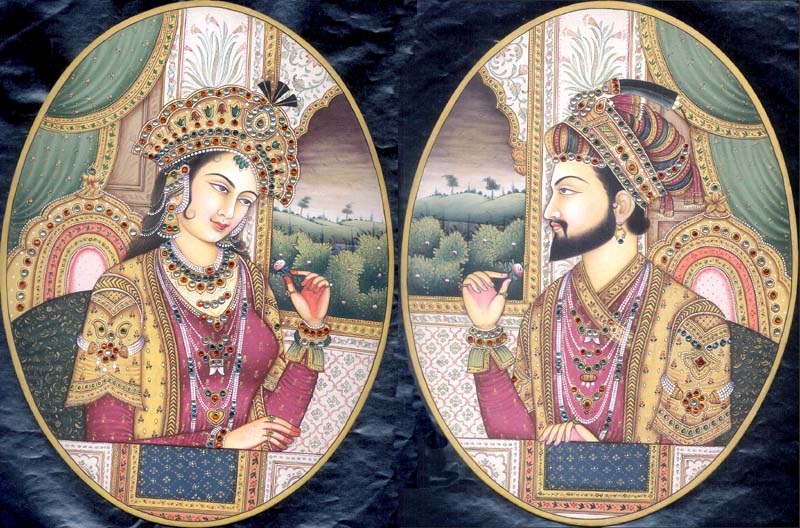
One of the greatest Indian love stories is of Shah Jahan’s love for his wife Mumtaz Mahal. The emperor erected the Taj Mahal in the memory of his dead wife while grieving for her. About 20,000 workers toiled day and night to create this masterpiece, which is today one of the Seven Wonders of the World.
The daughter of Shah Jahan’s father’s Prime Minister, Arjumand Banu Begum became Mumtaz Mahal when she was christened as the ‘jewel of the palace’ by Shah Jahan after their marriage. His inseparable companion till her end, she enjoyed the goodwill of the people for all her charitable work and just decisions. The king was never the same without her and was eventually captured and imprisoned by his own son Aurangzeb. He spent his last days looking at the monument he erected in her loving memory.
Today, there are few lovers like Shah Jahan and fewer like Mumtaz Mahal. If Shah Jahan was born today, he would definitely buy Mumtaz Mahal a garden of red roses, a store full of Swiss chocolates, personalized jewelry from Tanishq and have composers from across the world create music and write lyrics dedicated to her. No demonstration of devotion compares to the building of the Taj Mahal but in 2008 he might build a shopping mall with every other shop named after Mumtaz. Movies, plays, theater and drama try and capture the timeless essence of these immortal love stories in ways they decipher it, but nothing comes close to the simplicity of their love and dedication for each other.
Today, people seem to think love cannot be expressed with an empty wallet. Roses, chocolates, gifts, music and lyrics all cost money and love has become more an expression of the rich and famous rather than an emotion to cherish and reciprocate. Switch on your television and all the channels will showcase some advertisement selling gift ideas to express love. Gone are the eras of great love stories when love was expressed by a hesitant look and a simple glance.
The Origin of Tajmahal
The origin of the name the "Taj Mahal" is not clear. Court histories from Shah Jehan's reign only call it the rauza (tomb) of Mumtaz Mahal. It is generally believed that "Taj Mahal" (usually translated as either "Crown Palace" or "Crown of the Palace") is an abbreviated version of her name, Mumtaz Mahal (Exalted One of the Palace).
The Taj Mahal is a deserving resting palace for an Emperor's Empress. It stands on the banks of the river Yamuna, which otherwise serves as a wide moat defending the Great Red Fort of Agra, the center of the Mughal emperors until they moved their capital to Delhi in 1637. It was built by the fifth Mughal emperor, Shah Jahan in 1631 in memory of his second wife, Mumtaz Mahal, a Muslim Persian princess. She died while accompanying her husband in Burhanpur in a campaign to crush a rebellion after giving birth to their 14th child.
Mumtaj Mahal - "Build me a Taj"
As Mumtaz Mahal lay dying, she asked four promises from the emperor: first, that he build the Taj; second, that he should marry again; third, that he be kind to their children; and fourth, that he visit the tomb on her death anniversary. He kept the first and second promises. Construction began in 1631 and was completed in 22 years. Twenty thousand people were deployed to work on it. The principal architect was the Iranian architect Istad Usa; it is possible that the pietra dura work was coordinated by an Italian artist.
Taj Mahal - Wonder of the World
To people the world over, the Taj Mahal, mausoleum of Mughal Emperor shah Jana's chief wife, Mumtaz Mahal, is synonymous with India. Its curving, gently swelling dome and the square base upon which its rests so lightly is a familiar image from hundreds of brochures and travel books. The Taj is undoubtedly one of the most spectacular buildings of the world. Renowned for its architectural magnificence and aesthetic beauty, it counts among man's proudest creations and is invariably included in the list of the world's foremost wonders. As a tomb, it has no match upon earth, for mortal remains have never been housed in greater grandeur.
Architecture of the TajMahal
Construction began in 1631, and over 20,000 workmen and master craftsmen worked laboriously for 22 years to give shape to the emperor's passionate dream! The material was brought in from all over India and central Asia and it took a fleet of 1,000 elephants to transport it to the site. The complex was finally completed in 1653 at a cost of 32 Million Rupees (approx USD 68000) on the banks of river Yamuna in Agra, the capital of the Mughal monarchs.
But the beauty of Taj Mahal is also tainted by the gory fact that the hands of some of the master craftsmen were amputated, to ensure that the perfection of the Taj could never be repeated ever again!
The Story of Taj Mahal

The Taj Mahal was built by a Mughal emperor named Sahah Jahan, for his wife Mumtaz Mahal. Sahah Jahan was born in 1592, while his favorite wife Mumtaz Mahal was born in 1593. They married in 1612 and had seven children. In 1628 Shah Jahan became the Mughal Emperor. Only three years later his beloved wife died shortly after childbirth. In 1632 Sahah Jahan began the project of building a mausoleum, or tomb for his wife, the Taj Mahal.
The Taj Mahal is located on the banks of the Yamuna River. It took twenty-two years to complete with an estimated 20,000 workers. The building is surrounded by four 138 ft. minarets and sits on a 315 ft. square marble platform. Each side has a 110 ft. arch and center dome is around 200 ft. high. The building is built in an Islamic style of architecture.
Centered in the building is a tomb for Mumtaz Mahal. Next to her tomb, is the tomb for Sahah Jahan. The tombs in the building are empty. The bodies of the two are buried in a crypt below the building. The entire plan of the Taj Mahal is symmetrical, with one exception. Symmetrical means that one side of the building could mirror the other side if cut down the middle. The only exception is the tomb of Sahah Jahan which was added later to the building.
The Taj Mahal is located on the banks of the Yamuna River. It took twenty-two years to complete with an estimated 20,000 workers. The building is surrounded by four 138 ft. minarets and sits on a 315 ft. square marble platform. Each side has a 110 ft. arch and center dome is around 200 ft. high. The building is built in an Islamic style of architecture.
Centered in the building is a tomb for Mumtaz Mahal. Next to her tomb, is the tomb for Sahah Jahan. The tombs in the building are empty. The bodies of the two are buried in a crypt below the building. The entire plan of the Taj Mahal is symmetrical, with one exception. Symmetrical means that one side of the building could mirror the other side if cut down the middle. The only exception is the tomb of Sahah Jahan which was added later to the building.
There is a story which suggest that Sahah Jahan was planning on building a replica of the Taj Mahal for himself on the other side the river, though no evidence or plans of this has ever been found. Sahah Jahan was overthrown by his own son and imprisoned in the Red Fort within sight of the Taj Mahal. He was forced to spend the last eight years of his life in prison till his death in 1666.
Source: historylink102.com
Subscribe to:
Posts (Atom)
Popular Posts
-
 Here Am Going to explain, How to create blog for Google Adsense using Blogger.com and Weebly.com. What is Blogger.com? You need on...
 -
 All bridges serve a purpose, whether utilitarian or inspirational. And some of them add a distinct element of fear. But you don’t have to ...
 -
Shipping Track Aramex http://www.aramex.com/express/track.aspx Blazeflash http://www.blazeflash.net/track.aspx ...
-
.jpg) NELSON MANDELA A towering figure in 20th century history, Nobel Laureate Nelson Mandela showed how wisdom and patience c...
NELSON MANDELA A towering figure in 20th century history, Nobel Laureate Nelson Mandela showed how wisdom and patience c... -
.jpg) MARTIN LUTHER KING JR Martin Luther King, Jr’s father was a minister. He attended Booker T. Washington High School, an...
MARTIN LUTHER KING JR Martin Luther King, Jr’s father was a minister. He attended Booker T. Washington High School, an... -
Coca Cola Thums Up ...
-
 We tend to hold inventors in high esteem, but often their discoveries were the result of an accident or twist of fate. This is true...
 -
1) Norway and Sweden - Snowmobilers line up to ride the pathway of removed trees making up the border between the two Nordic nations. ...
-
1.) A butter stick, for all of your everyday buttering needs! 2.) This motorized ice cream cone. No need to lick around the cone lik...